


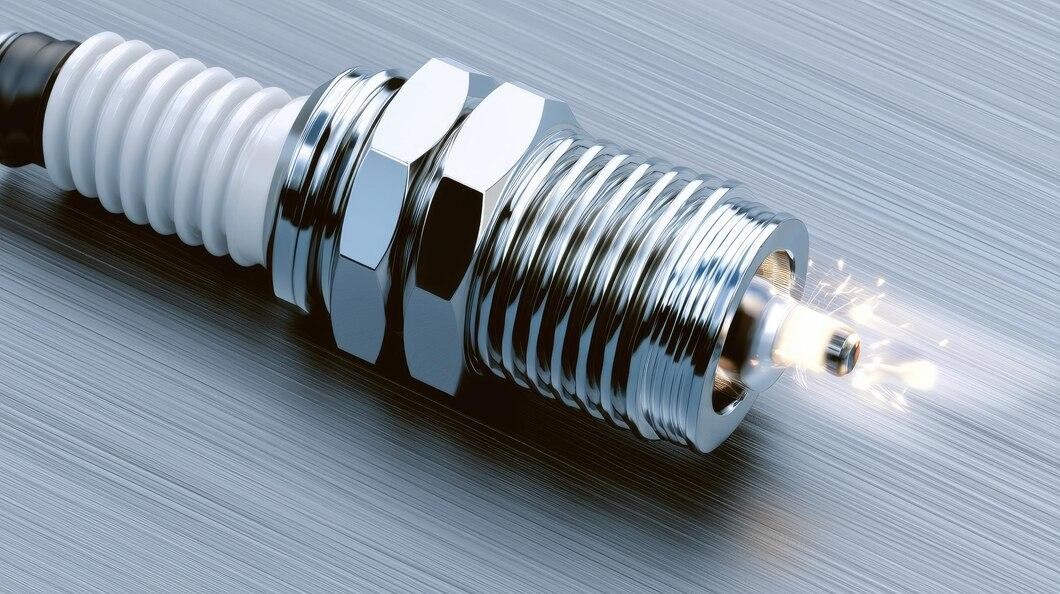
Have you ever wondered how your engine comes to ignition every time you tap on the self-start button? It's all thanks to a small but mighty component called the ignition plug. Invented by a French-Belgian engineer in 1860, its improved version was later patented by Nikola Tesla and Robert Bosch in 1898 which then made it to mass production.
Let's dive into the world of ignition plugs and understand their crucial role in starting and running your engine. Here’s a brief overview of the uses, importance and maintenance of spark plugs.
Construction of a Spark Plug
A spark plug may vary in size and the material used, but generally, it is the combination of a shell, an insulator and a central conductor. The spark plug is directly connected to a high voltage alternator/ ignition coil. The current flows to the central and side electrode and once the current reaches a set limit, it begins to ionize the gases in the chamber.
Thereafter, this ionized gas inside the chamber becomes a conductor and allows the current to flow between the gap in sync with the air that is pulled in and injectors that spray the fuel, thus resulting in combustion.
What exactly is an Ignition Plug?
An ignition plug, also known as an automobile spark plug, is a component that creates the spark necessary to ignite the fuel-air mixture in your engine's combustion chamber. It is essentially the heart of your engine's ignition system. Its design has also evolved from 2 stroke to now 4 stroke ignition engines.
Types of Ignition Plugs
There are primarily two types of ignition plugs powering engines based on their function: -
• Spark Ignition Plugs: These are used in engines that ignite the fuel-air mixture with a spark. This includes most gasoline-powered vehicles (petrol only) , two-wheelers, cars, and light commercial vehicles.
• Compression Ignition/Glow Plugs: These are used in diesel engines where the fuel-air mixture ignites due to high compression, not a spark. They primarily work on heating the fuel to the point that it burns itself.
How Does an Ignition Plug Work?
1. Current Flow: When you turn on the ignition, an electrical current flow through the ignition system. The top spark plug contains a terminal to connect to the ignition system. It has a central electrode that extends into the combustion chamber, creating a spark gap with the side or ground electrode.
2. Spark Generation: This current reaches the ignition plug, where it creates a high-voltage spark between the electrode and the ground electrode. When the high voltage is applied, the insulation tends to break down and an electric spark is generated.
3. Ignition: This spark ignites the fuel-air mixture in the combustion chamber, causing a powerful explosion that drives the piston in the opposite direction, driving the crank as well as the plates in the transmission.
In modern four stroke engines, the first stroke is the air-fuel mixture pulled in, the second stroke accounts for compression, the third stroke is the actual combustion and the fourth stroke is the emitted gases pushed out for a fresh combustion cycle.
Key Components of an Ignition Plug
An ignition plug consists of several essential components: -
• Electrode: The tip of the plug that delivers the spark.
• Ground Electrode: The part of the plug that completes the electrical circuit.
• Insulator: A ceramic material that prevents the spark from arcing to other parts of the engine.
• Seal: A gasket that prevents leaks between the plug and the cylinder head.
Importance of Ignition Plugs
Ignition plugs play a vital role in the performance and efficiency of your engine:
• Starting: They provide the initial spark needed to start the engine.
• Combustion: They ensure complete combustion of the fuel-air mixture, leading to optimal power output.
• Fuel Efficiency: Well-functioning ignition plugs contribute to better fuel economy.
• Emissions: They help reduce emissions by ensuring efficient combustion.
Ignition Plugs by TVS Motor
At TVS Motor, we understand the importance of ignition plugs in ensuring the smooth and efficient operation of our motorcycles. Our engineers carefully select the right ignition plugs for our ET-Fi/ RT-Fi enabled engines in each model to deliver a perfect blend of performance and fuel efficiency ranging from commuter two-wheelers (110-125 cc category), and all the up to performance category (our 312 cc platform).
Maintaining Your Ignition Plugs
To ensure the longevity and performance of your ignition plugs, follow these tips:
• Regular Inspections: Have your ignition plugs inspected as recommended in your motorcycle's service manual.
• Replacement: Replace worn-out or damaged plugs to prevent engine performance issues.
• Quality Plugs: Use only high-quality ignition plugs from reputable brands.
By understanding the role of ignition plugs and taking proper care of them, you can help maintain the optimal performance and efficiency of your two-wheeler.
Also Read:
Checking Spark Plugs For Their Health And Efficacy Mumbai Maintenance