Have you ever noticed uneven tyre wear after just a few months of riding? Or that you’ve found yourself accelerating more to reach that desired speed?
It’s easy to forget about tyre pressure when you’re in a rush, but it’s actually one of the biggest factors in a safe, smooth, and fuel-efficient commute. The TVS Jupiter 125 is engineered for practical daily use, and correct tyre pressure plays a big role in how it performs.
So, what happens when the tyre pressure of your TVS Jupiter 125 isn’t where it should be? Let’s understand.
Understanding Tyre Pressure: Why It Matters
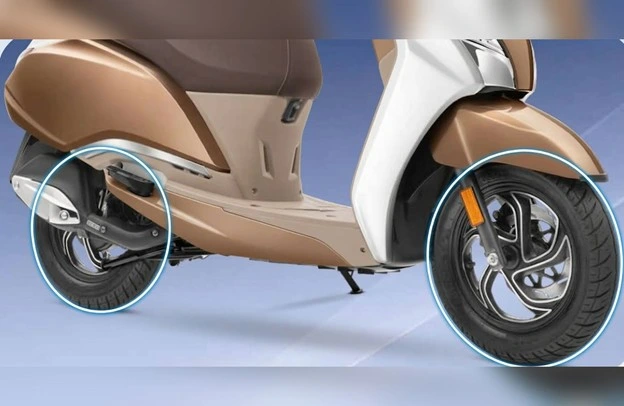
Tyre pressure simply tells how the rubber compound interacts with the road. When inflated correctly to 24 PSI (front) and 36 PSI (rear), the contact patch, which is the area of the tyre actually touching the road, is right-sized for grip, stability, and even wear.
-
● Under-inflation causes the sidewalls to flex too much, which builds up heat and wears out the tyre faster.
-
● Over-inflation keeps the contact patch small, which means less grip during braking or cornering.
Ever wondered why it matters more on Indian roads? Because going from smooth tarmac to broken patches within a few metres is not new to Indian riders.
Here's why it matters to maintain correct tyre pressure in the TVS Jupiter 125:
-
● Better Fuel Efficiency: The right tyre inflation reduces rolling resistance. The engine doesn't have to work hard to overcome friction, which means better mileage. Even small fuel savings can add up quickly and offset the not-so-pocket-friendly fuel prices.
-
● Enhanced Safety: Correctly inflated tyres grip the road better during acceleration, braking, and cornering. The Synchronized Braking Technology (SBT) on the Jupiter 125 works as designed when tyres hold the road firmly, giving you full control over how quickly and safely you stop.
-
● Extended Tyre Life: Even wear increases the life of a tyre. Under-inflated tyres wear out at the edges, while over-inflated ones wear in the centre, which means buying new tyres sooner than needed.
Why 125cc Scooter Tyre Pressure Varies
Unlike motorcycles, scooters carry their weight differently. The rear wheel handles most of the load - rider weight, pillion, luggage, and that 33-litre under-seat storage that makes the Jupiter 125 so practical. That’s why the specifications for scooter tyre pressure have a higher rear PSI compared to the front.
-
● 24 PSI is fixed for steering precision and comfort, which makes the front tyre absorb initial impacts from potholes and speed breakers.
-
● 36 PSI at the rear provides the stiffness needed to handle different loads without the scooter bottoming out or causing too much tyre flexing.
-
● Temperature also plays a role. During the summer months, air molecules inside the tyre expand, which often increases the pressure. In winter, these molecules contract, reducing the pressure. That’s why regular checks are important once every two to three weeks.
How it Feels on the Road
Take a typical scenario: riding through Gurugram traffic with a pillion and groceries in that 33-litre under-seat storage. If your TVS Jupiter 125 tyre pressure is low, the scooter will feel heavy, sluggish, and shaky through corners. Get the pressure right, and you feel the difference instantly; it’s stable at high speeds, sharp through the turns, and you feel more in control.
The telescopic front forks and adjustable rear shock absorbers work in sync with proper tyre inflation. The suspension handles the bumps, while correct tyre pressure ensures controlled damping and rebound. Together, they keep the ride comfortable and planted.
The Right Way to Check
Check pressure when tyres are cold, that is, before riding or after the scooter's been parked for at least three hours. It is good to keep a digital pressure gauge, as petrol pump gauges aren't always accurate. You can stick to 24 PSI front and 36 PSI rear, and go slightly higher if you regularly ride with a pillion or heavy loads.
It's a simple habit that ensures your Jupiter 125 delivers what it's built for - good mileage, safe rides, and the confidence to handle whatever Indian roads throw at you.
Book a test ride today!
View All TVS Scooters
FAQs
Q1. What is the recommended tyre pressure for the TVS Jupiter 125?
A1. The recommended tyre pressure is 24 PSI for the front tyre and 36 PSI for the rear tyre to ensure better performance, improved safety, and fuel efficiency.
Q2. Why does the rear tyre need higher pressure than the front?
A2. The rear tyre carries most of the load, including rider weight, pillion, luggage, and the 33-litre under-seat storage, which is why it requires higher pressure (36 PSI) for proper stiffness and stability.
Q3. How does tyre pressure affect fuel efficiency?
A3. Correct tyre inflation reduces rolling resistance, meaning the engine doesn't work hard to overcome friction, which results in better mileage that adds up to fuel savings.
Q4. When should I check tyre pressure on my Jupiter 125?
A4. Check tyre pressure when tyres are cold, mainly before riding or after the scooter has been parked for at least three hours, and do this once every two to three weeks for best results.
-------------------------------------------------------------------------------------------------------------------------------------
Also Read:
TVS Jupiter 125 Max Speed: What Every Rider Should Know
2026 TVS Jupiter 125 DT SXC – More Value in Every Ride
Buying a Scooter for City Traffic? Here’s Why TVS Jupiter 125 Stands Out